All fields
02 · SCIENTIFIC WORK
From a hypothesis to an attributable experiment.
An agent can connect planning, protocols, instruments, observations, evidence, and review without detaching the experiment from the people responsible for it.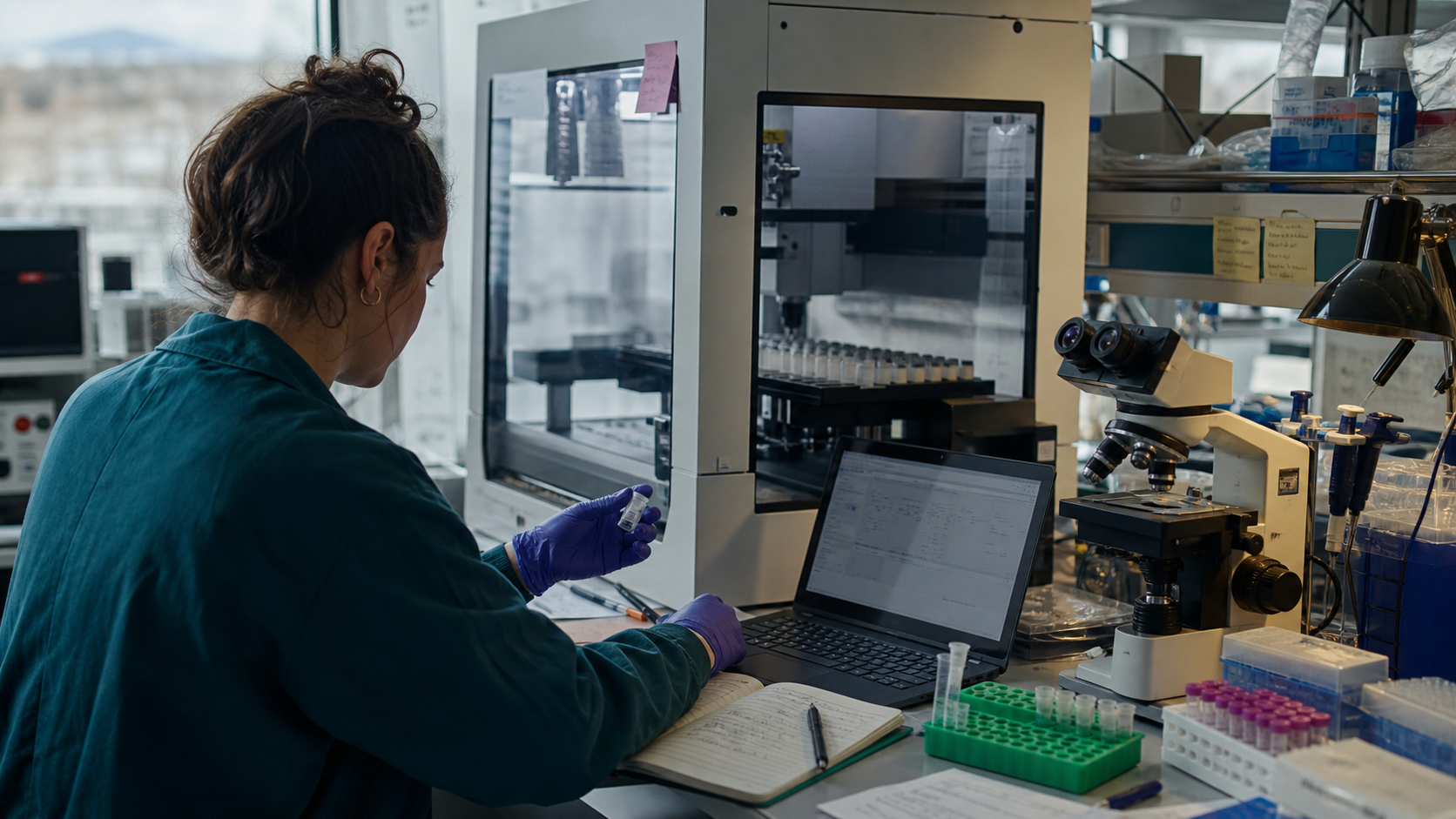
THE OUTCOME
A reproducible experimental record in which preparation, execution, observations, exceptions, and human decisions remain connected.
INTERACTIVE SIMULATION
An experiment as a continuing record.
Advance a simulated laboratory run. Agent action, instrument state, and human approval remain visibly distinct. SIMULATED RUNEX-0247 · Protein stability screen
0% · Prepare
SCIENTIFIC WORK
Run control
Interactive preview
PLATE MAP · A1–H1296 wells
RUN RECORDAgent Instrument
Protocol, samples, and instrument state reconciled.
Deck scan completed. 24 positions recognized.
THE WORKPLACE COMES WITH YOU
Stay in the work.
Stay connected to your agents.
Your agents bring identity, files, memory, communication, and permissions into the same assignment. Spatial computing makes the connection fit your surroundings—from a focused screen to a brief spoken update. Your location never grants additional authority.
Explore the spatial experience Illustrative product scenarios. Integration availability depends on your deployment.THE AGENT CARRIES
Prepare protocols and instrument context
Coordinate runs and capture observations
Link evidence back to the hypothesis
ITS HUMAN DECIDES
Authorize procedures and safety boundaries
Intervene on anomalies
Interpret and accept the conclusion
ONE CONTINUING ASSIGNMENT
A day in the work.
Prepare the run
Check the protocol, samples, instrument state, and prior evidence.
01Authorize execution
Confirm the procedure and the boundary conditions that matter.
02Observe and connect
Capture readings, deviations, media, and instrument events as they occur.
03Interpret the evidence
Review the anomaly together and record the scientific judgment.
04AN ASSIGNMENT IN PRACTICE
Make the experiment easier to inspect, not easier to overstate.
Consider a lab comparing two preparation methods using an already approved protocol. The useful assignment is to keep the plan, sample references, observations, and interpretation connected. This scenario is about the work around an experiment, with scientific judgment and procedure authorization remaining with the responsible researchers.
Illustrative product scenario. These are proposed experience requirements, not a customer case study or a statement of current integration availability.
What goes into the assignment.
Start with the question being tested, the approved protocol version, sample identifiers, planned comparisons, and the researcher who owns the run. Specify which records the agent may read and where observations belong. The agent should surface unresolved sample labels or missing readiness information before treating the preparation as complete. A scheduled instrument slot alone is not permission to begin a procedure.
What a useful outcome contains.
The intended deliverable is a reviewable experiment packet: the plan used, linked observations, any deviations, the analysis prepared for review, and unresolved questions. Raw observations should remain distinguishable from the agent’s summary and the researcher’s interpretation. A reader needs to see why a conclusion was proposed, including evidence that does not fit it, and which parts still require scientific judgment.
A connection that respects the bench.
At the bench, a short spoken note could capture a sample observation when that interaction is appropriate for the setting. At a review station, the same observation should appear beside its sample and protocol step. If a note is ambiguous, ask the researcher to resolve it; location and timing can help organize a record but should not substitute for identifying the sample.
An interrupted run remains part of the evidence.
If an instrument connection drops, the agent should mark the record incomplete and preserve the last confirmed observation. It should not infer missing readings or label the run successful. The responsible researcher decides whether to recover data, repeat a step, or exclude a result. That decision and its rationale belong with the original run, including any linked repeat.
Record quality does not establish scientific validity.
A connected record can make review easier; it cannot by itself establish that a method is appropriate or a finding reproducible. Begin by evaluating preparation and documentation around a bounded protocol. Instrument control, sensitive data access, and procedure changes require separate assessment of the actual lab, equipment, integrations, and authorization involved.
START WITH A REAL ASSIGNMENT
What would make this useful for you?
Use these questions to evaluate one bounded piece of work in your own setting.
- Can a reviewer identify the exact protocol and samples behind each observation and proposed conclusion?
- Does an incomplete run remain visibly incomplete, even when a polished summary can be generated?
- Can the researcher correct an interpretation while preserving the observations and the reason for the correction?

WHY CONTINUITY MATTERS
The experiment is not an isolated tool run. It becomes part of the agent’s continuing memory of the lab, its instruments, its people, and its evidence.
NEXT FIELD · MACHINES
From a planned action to governed physical work.