All fields
03 · MACHINES
From a planned action to governed physical work.
The same identity that prepares work in software can operate authorized equipment while people retain explicit control over limits, exceptions, and intervention.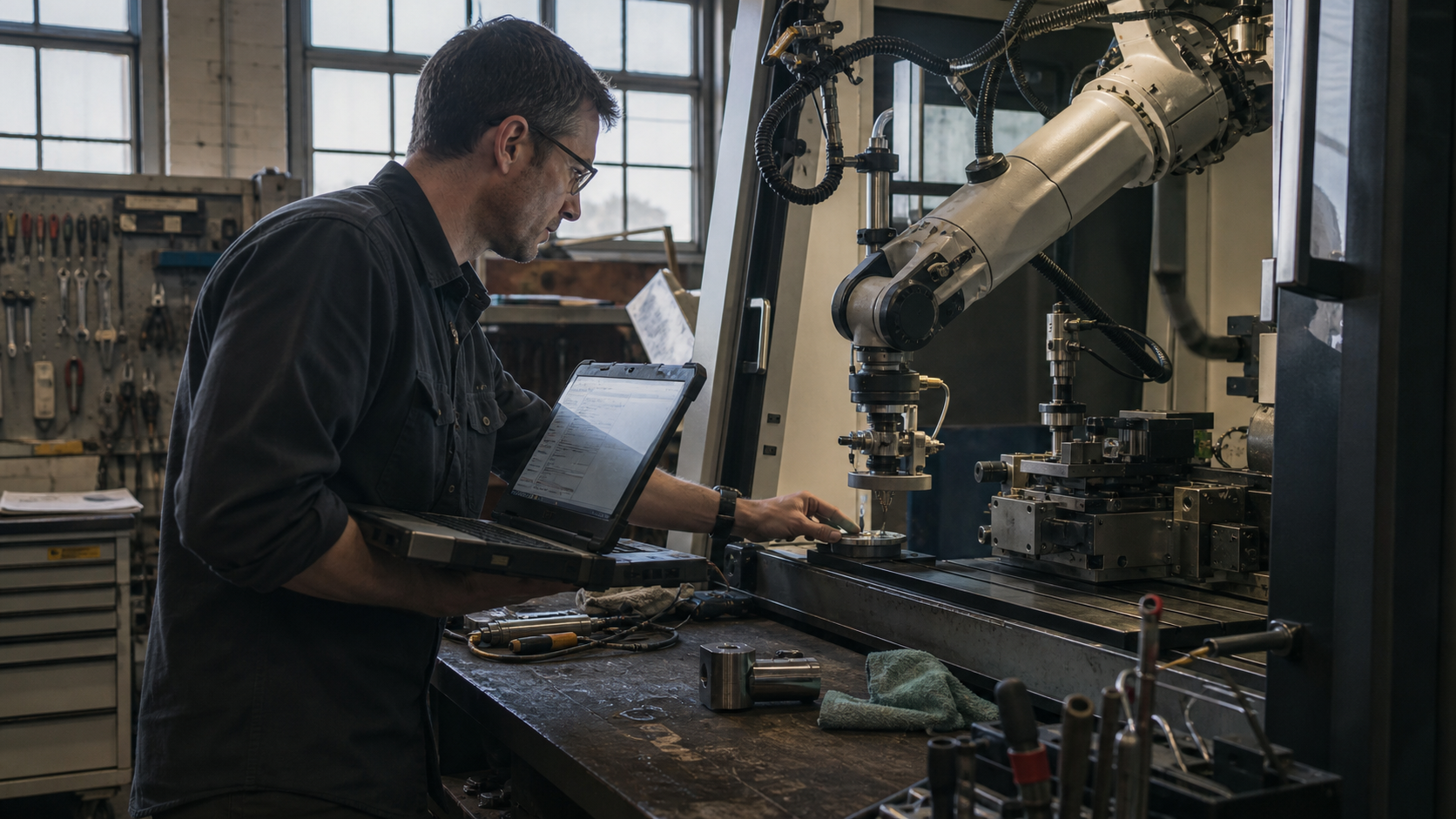
THE OUTCOME
A completed machine operation whose command, authority, sensor evidence, intervention, and result can be traced to one continuing record.
INTERACTIVE SIMULATION
Physical action inside a visible boundary.
Release one bounded movement, observe its live state, and retain the command and result in the same record.MACHINE WORK · SIMULATED CELL M-14
Inspection transfer
Move carrier 02 from Station 2 to Station 3, then stop.
HeldMC-02 · simulated governed edge link
Station 20%Station 3
BOUNDED OPERATION
One route. One payload. One stop.
- Speed limited to 0.18 m/s
- Safety zone A3 remains locked
- No autonomous route changes
- Release expires after completion
PHYSICAL APPROVALRelease this movement once
The agent has prepared the operation. A human must authorize its physical effect.
EVENT RECORD Streaming
Inspection route prepared inside Cell M-14.
Interlocks, clearance, and payload verified.
THE WORKPLACE COMES WITH YOU
Stay in the work.
Stay connected to your agents.
Your agents bring identity, files, memory, communication, and permissions into the same assignment. Spatial computing makes the connection fit your surroundings—from a focused screen to a brief spoken update. Your location never grants additional authority.
Explore the spatial experience Illustrative product scenarios. Integration availability depends on your deployment.THE AGENT CARRIES
Translate intent into bounded procedures
Coordinate machines and sensor feedback
Pause, recover, and document exceptions
ITS HUMAN DECIDES
Grant machine-specific authority
Confirm irreversible actions
Take over whenever conditions leave policy
ONE CONTINUING ASSIGNMENT
A day in the work.
Inspect readiness
Compare the task with machine state, maintenance, tools, and constraints.
01Release the job
Approve the physical operation and its intervention boundary.
02Operate and observe
Coordinate execution while monitoring the signals that matter.
03Close the loop
Review the result, exception history, and next maintenance action.
04AN ASSIGNMENT IN PRACTICE
Carry a workshop job through the exception, too.
A workshop wants to make a small fixture from an approved drawing. Preparation crosses design files, stock availability, equipment readiness, job notes, and an operator’s review. This scenario shows how an agent workplace could keep those pieces together while any physical operation stays within the equipment’s established operating procedures.
Illustrative product scenario. These are proposed experience requirements, not a customer case study or a statement of current integration availability.
What goes into the assignment.
Provide the drawing revision, intended material, acceptance criteria, permitted equipment, and the person responsible for releasing the job. The agent could organize the job packet, compare requested materials with available records, and identify questions for the operator. It should make the planned operation and its assumptions inspectable before requesting authority to affect a machine.
What a useful outcome contains.
A completed assignment includes the approved job packet, the operation record available from the equipment, any operator interventions, and the result of the agreed inspection. If the fixture fails an acceptance check, the outcome is a documented exception with a proposed next step. Producing a part is not the same as producing an accepted part, and a completed command is not evidence of either.
At the workstation, show what matters now.
A screen beside the machine could focus on the current job, confirmed state, and the next operator decision. Away from the workshop, a status update can say that the job needs attention and why. The experience should distinguish viewing a job remotely from having authority to operate equipment; arriving near a machine should not automatically expand that authority either.
No blind replay after a lost connection.
If acknowledgement of a command is missing, the agent should show that the result is unknown rather than assume the command failed. The operator needs to establish the actual machine and workpiece state before considering another action. Retain the original request, last confirmed feedback, and recovery decision so a repeated command cannot be mistaken for the first attempt.
The workplace is not the machine’s safety system.
Begin with job preparation and review, then evaluate any proposed equipment connection separately. Visca’s product scenario does not replace machine controls, guarding, operating procedures, or the operator’s responsibilities. The relevant question is whether the particular integration can make authority, actual state, intervention, and completion clear enough for the intended job—not whether an agent can issue a command.
START WITH A REAL ASSIGNMENT
What would make this useful for you?
Use these questions to evaluate one bounded piece of work in your own setting.
- Can the operator inspect exactly which drawing, material, equipment, and operation an approval covers?
- After interrupted communication, is an unknown outcome clearly different from a failed or completed operation?
- Does closing the assignment require the agreed inspection result, including any rejected or unfinished work?
WHY CONTINUITY MATTERS
A machine is a governed capability of the agent—not a second identity, a disconnected console, or a record that disappears after the run.
NEXT FIELD · PHYSICAL EMBODIMENT
Acquire new bodies without losing the self.