Model · provider · computer · interface · body
VISCA RESEARCH
The intelligence changes.
The agent continues.
A useful agent is a continuing, accountable participant—not a disposable model session.
We study the properties required for the same agent to retain evidence, identity, authority, memory, and history as it moves across software, laboratories, machines, and physical bodies.THE VISCA HYPOTHESIS
Intelligence may be replaceable. Accountability cannot be.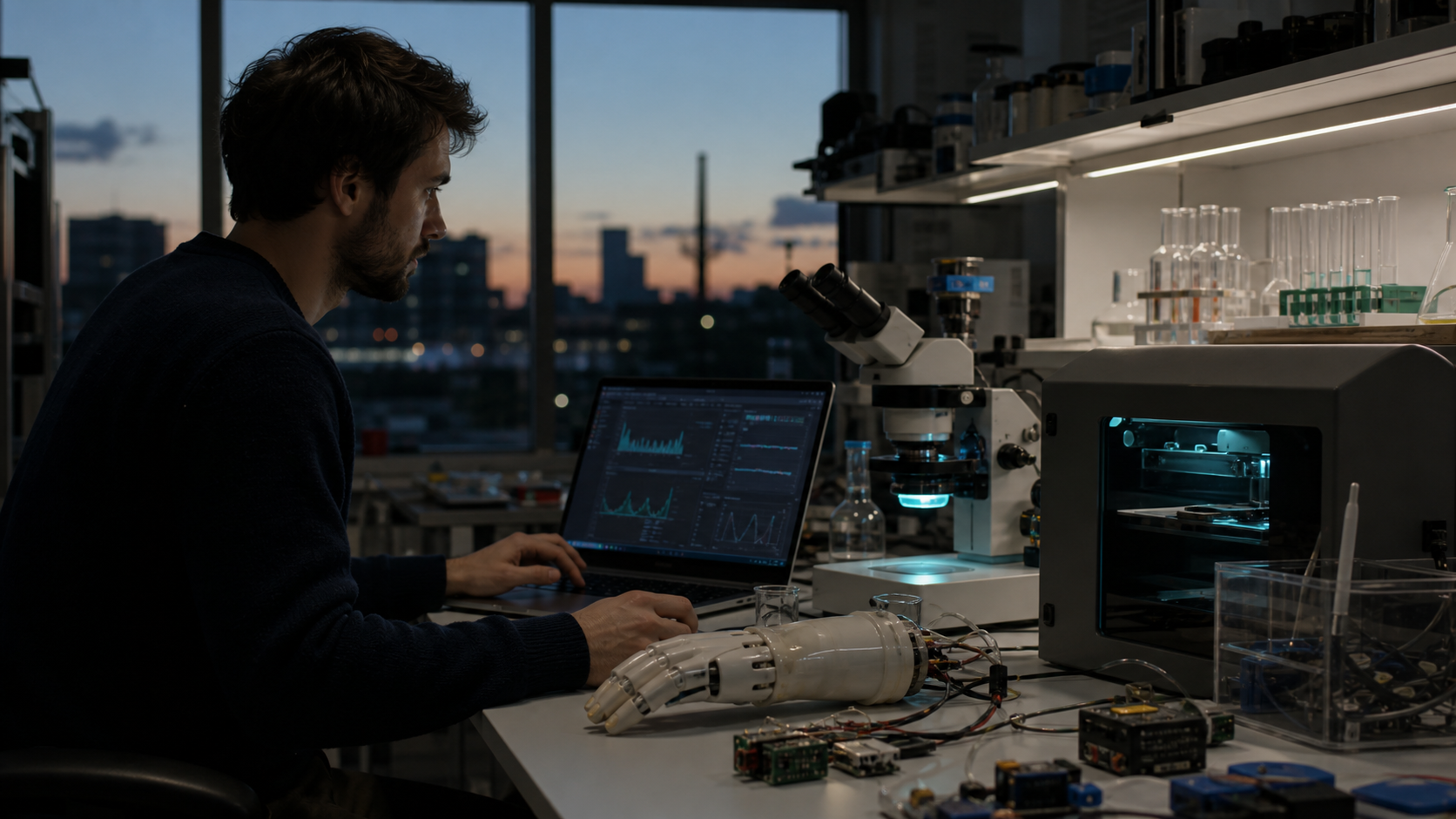
ONE IDENTITYONE CONTINUING RECORDMANY PHYSICAL FORMS
Identity · memory · authority · relationships · record
Software · laboratories · machines · the physical world
Every transition is attributable Every consequential action remains governed
THE FIVE PROPERTIES
Five properties of an agent you can rely on.
Each property is a system requirement with a concrete question it must answer under real operating conditions.
Verifiable
Claims, decisions, and outcomes remain connected to the evidence and environment state that produced them.
TESTCan an authorized reviewer move from an outcome back to its observations, sources, and approvals?Interoperable
Identity, memory, relationships, and authority survive changes in models, providers, tools, computers, and physical forms.
TESTCan the substrate change without creating a new agent or losing the accountable record?Secure
Every capability is bound to explicit identity, least-privilege authority, human-defined limits, and immediate revocation.
TESTCan a consequential action be denied, constrained, or stopped at the boundary where it matters?Cognitive
Working memory integrates goals, people, evidence, constraints, and changing world state without confusing observation with inference.
TESTCan the agent explain what changed, what it knows, what it inferred, and what remains uncertain?Auditable
Intent, context, approvals, model and tool paths, actions, interventions, observations, and outcomes form one inspectable history.
TESTCan the work be reconstructed end to end—including who authorized it and what the world returned?CURRENT TRACKS
Proof before promise.
Our research asks what a useful agent must retain as the work, the environment, and its capabilities change.
RESEARCH DIRECTION
CONTINUITY
One identity across changing intelligence
Testing whether work, relationships, authority, and memory survive changes in model, provider, tool, and compute environment.Explore the fieldRESEARCH DIRECTION
SCIENTIFIC WORK
An experiment as a continuing record
Connecting hypotheses, protocols, instruments, observations, anomalies, evidence, and human interpretation without breaking provenance.Explore the fieldRESEARCH DIRECTION
EMBODIMENT
New bodies without a new self
Treating hands, sensors, mobile platforms, and machines as governed capabilities of a persistent agent—not isolated identities.Explore the fieldWhat would count as convincing evidence?
A research direction needs a way to be challenged. These proposed evaluation questions make our continuity thesis concrete; they are not published benchmark results or claims of completed validation.
Illustrative design scenario
Change one boundary while the work continues
Begin with an assignment whose state can be inspected: inputs, owner, authorized actions, open decisions, and a known target result. Run it in a controlled setting. Then change one condition, such as the model, the working device, a collaborator’s access, or the availability of a tool. Keep the other conditions visible so the effect of the change can be understood.
Evaluate more than whether the agent eventually produces an answer. Did it retain the current decision? Did it use an outdated file? Did it repeat an external action whose result was uncertain? Could a reviewer distinguish an observation from an inference? A polished final artifact can hide a broken path to that artifact.
A useful report records the setup, the change, the expected behavior, the observed behavior, and the failure. It should also explain what was simulated and which dependencies were real. That distinction allows someone else to judge how far the result travels beyond the demonstration.
The research question becomes inspectable: what continuity was preserved, what was lost, under which conditions, and what additional work is required before the behavior can be relied upon?
The cases worth designing for.
Separate quality from continuity
A model may write a better summary while losing the latest approval or ownership information. Evaluate the quality of the output and the integrity of the working record separately. Neither result can stand in for the other.
Include interruption and disagreement
Test missing inputs, conflicting contributions, revoked access, and ambiguous outcomes. These cases reveal whether the system has a coherent account of the work or merely a convincing path through an ideal demonstration.
Treat human effort as part of the result
Record how often people reconstruct context, correct assumptions, or repeat instructions. An agent that finishes only through constant invisible coordination has not achieved the experience the product is aiming for.
What to look for in an evaluation.
- Can another reviewer reconstruct the evaluation from its record?
- Are failures and untested conditions stated beside the successful behavior?
- Does the demonstration distinguish its research hypothesis from an available capability?
THE STANDARD
If the identity breaks at the boundary, the system is not finished.
A useful agent should not become a stranger each time the model changes, the software closes, or a machine turns on.
Read the manifesto