Visca

Solutions / Role

Security & compliance

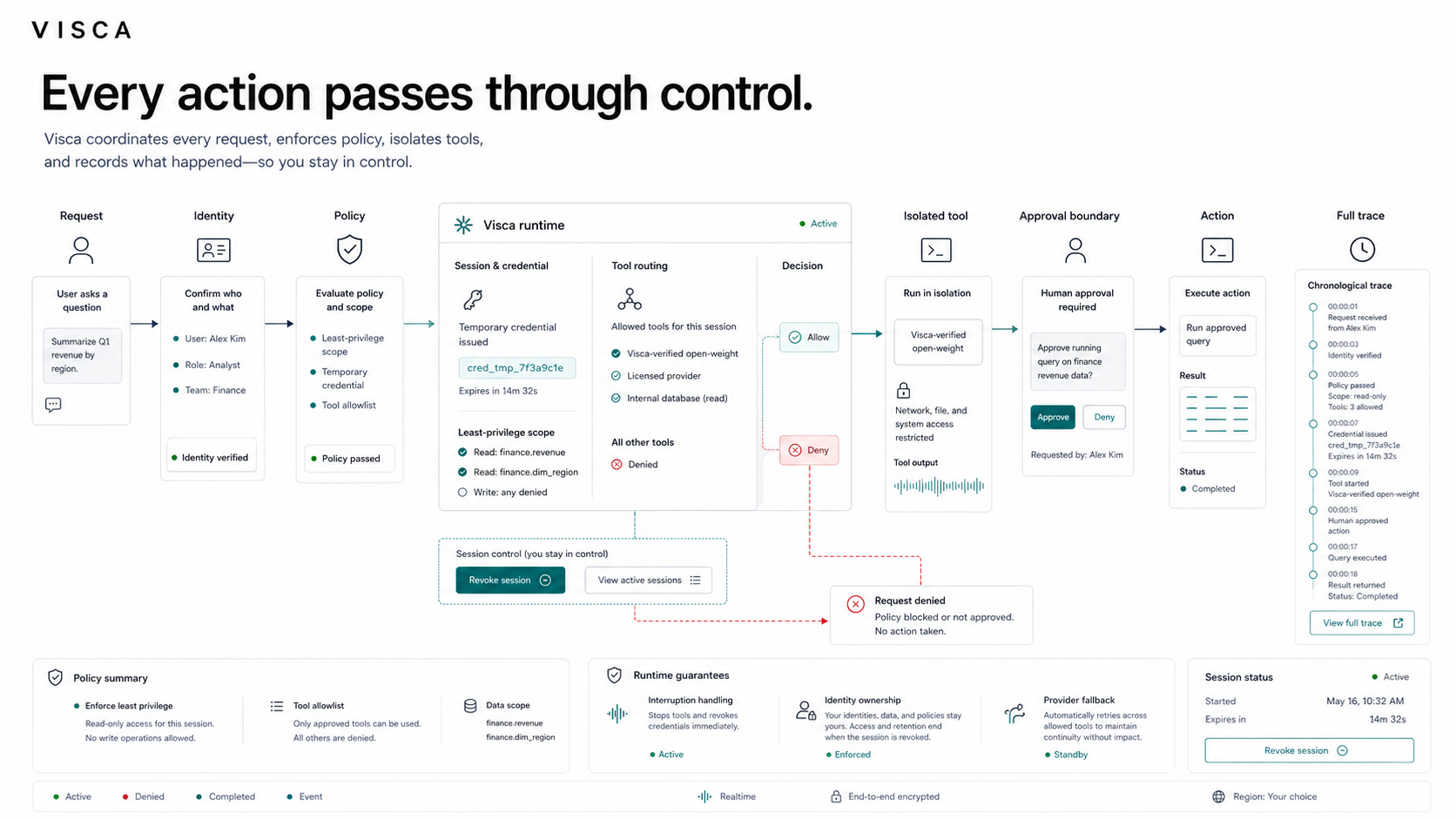
Reviewers and agents working from the same live trace—with explicit identity, least privilege, approvals, revocation, and one audit record.You're accountable for agents you didn't build and can't fully see. Hosted AI vendors are data egress you can't sign off; a self-hosted stack stitched from a dozen projects hands you a dozen identity models and audit trails to correlate by hand — plus hand-run maintenance that never appears in the evidence at all. Visca makes the answers structural: every agent is a named principal, every access is a scoped credential, and every operation — maintenance included — passes through one governed gateway onto one tamper-evident ledger. Most of what you'd write as policy is a property of the stack.
People and AI collaborating in a governed security & compliance workspace

Why this work needs a system boundary

Shared AI work is useful only when authority, data, and consequences remain controlled.

01

Agents with credentials you can't scope

Production agents hold broad, long-lived credentials. Your policy says least-privilege; the infrastructure offers all-or-nothing.

02

Audit you have to assemble

Answering an incident or an examiner means correlating framework traces, tool logs, identity events, and model-provider logs by hand. The answer takes hours; the question is urgent.

03

Maintenance off the record

SSH sessions, console clicks, tribal knowledge — how the stack is kept alive never shows up in the evidence. You find out what was changed, and by whom, during the incident it caused.

One shared workspace, not scattered agent threads

The collaboration and control plane around every participant, model, tool, and action.

01Identity

No actor without identity

Least-privilege starts with knowing who's acting. Every agent is a named principal with a verifiable identity, by construction — 'who is this agent' has one answer.

02Credentials

No access without a scoped grant

Long-lived credentials disappear. Every access is scoped, time-bound, consented where required, and audited — least-privilege as the only available mode.

03Runtime

Nothing leaves the perimeter

Models, prompts, and data execute inside your walls. The egress finding never opens, and there's no vendor chain to review one contract at a time.

04Audit

No action unaccounted for

Every operation is a principal acting within a scope through one governed gateway — append-only, chained, exportable to your SIEM and GRC tooling. The control isn't asserted; it's recorded.

05Operators

Maintenance as evidence

Patches, rotations, and recoveries are performed by the stack's own operators as principals in scopes — signed, on the same ledger you read. Humans keep three jobs: declare intent, sign approvals, hold the kill-switch.
What the institution gets

Durable control without giving up capability.

  • Least-privilege enforced by the stack, not by policy review
  • Incident and examiner questions answered with one query
  • Evidence generated as a side effect of operation — maintenance included
  • SIEM / GRC export for Splunk, Datadog, Snowflake, ServiceNow

In practice

A security review that doesn't block the launch

An application team wants to ship an agent with production access. The review is short: the agent is a named principal, its access is scoped and time-bound, every action lands tamper-evidently on one ledger — and the stack underneath is maintained by operators whose every patch and rotation is on the same record. The controls aren't promises in a doc; they're properties of the runtime, with evidence.

Other teams

Give AI a place on the team—and keep it under your control.

Give every AI a persistent identity, presence, and shared workspace. Collaborate live through our cloud or entirely on infrastructure you control.