Why this work needs a system boundary
Shared AI work is useful only when authority, data, and consequences remain controlled.
01A different stack per agent type
Voice agents, coding agents, document agents, and robots each arrive with their own identity, logging, and deployment model. You become the integration tax.
02Guardrails as tribal knowledge
Every team reinvents budgets, fallbacks, and access policy in application code. Consistency is a wiki page nobody reads.
03You become the ops org
Every project in the stitched stack has its own upgrade cycle, patch cadence, and failure modes. The maintenance compounds with each addition — and it all pages your team.
One shared workspace, not scattered agent threads
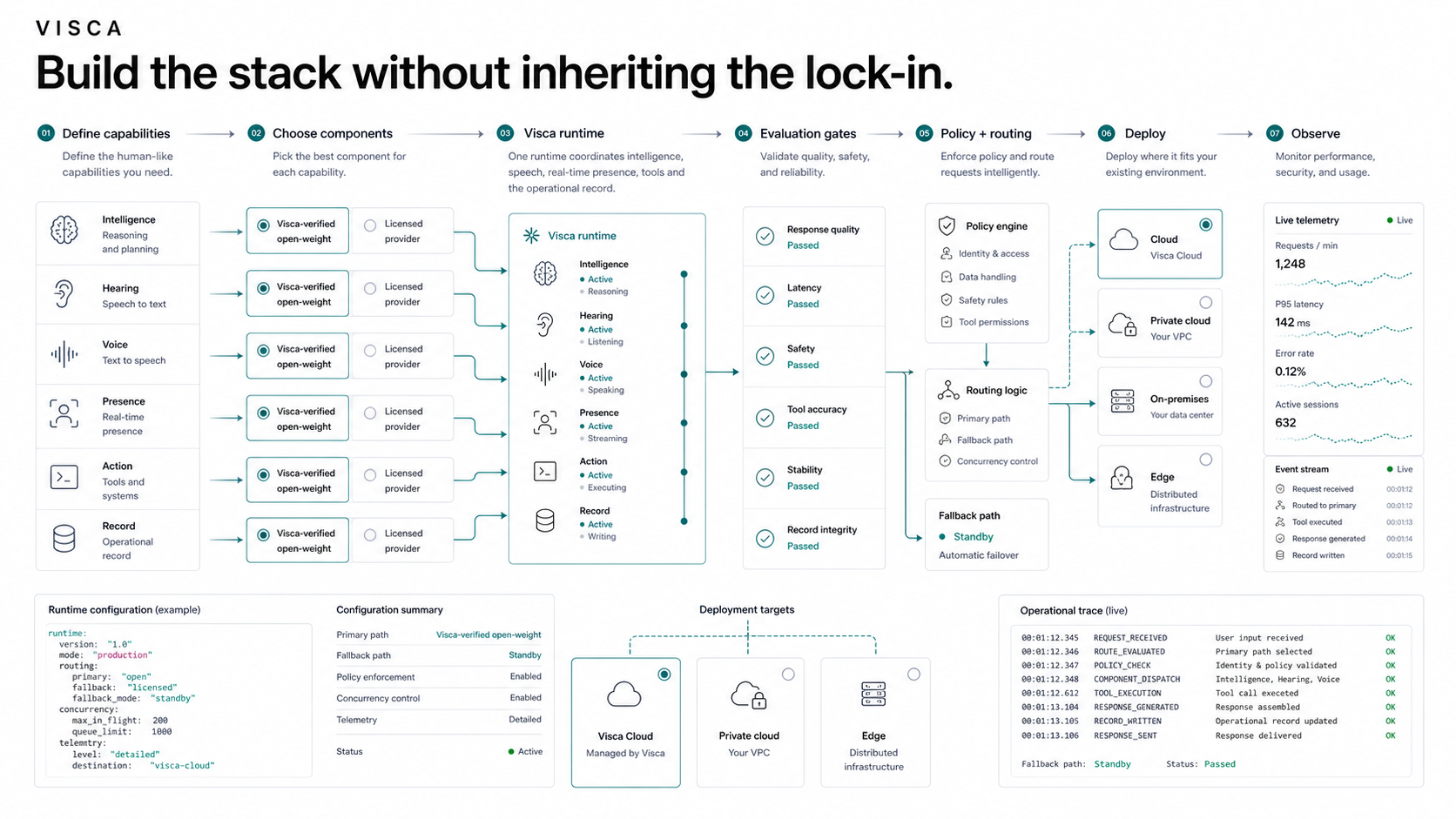
The collaboration and control plane around every participant, model, tool, and action.
01IdentityOne identity model across the estate
Every actor, regardless of agent type, carries the same shape of identity. One revocation path, one lineage model, one answer to 'who is this.'
02CredentialsGuardrails by construction
Scoped, time-bound credentials are the only mode the stack offers. Teams can't reinvent access policy in application code, because there's nothing standing to hand out.
03RuntimeOne operational surface
Every agent category runs on the same in-perimeter runtime, with budgets and limits enforced by the substrate rather than by convention.
04AuditLeadership's questions, answered
How many agents are in production, what can they touch, what have they done — one queryable, tamper-evident record instead of a dashboard that doesn't exist.
05OperatorsThe maintenance you don't staff
The stack's own operators handle deploys, upgrades, patches, credential rotation, and incident response in-perimeter. Your team declares intent, signs approvals, and holds the kill-switch.