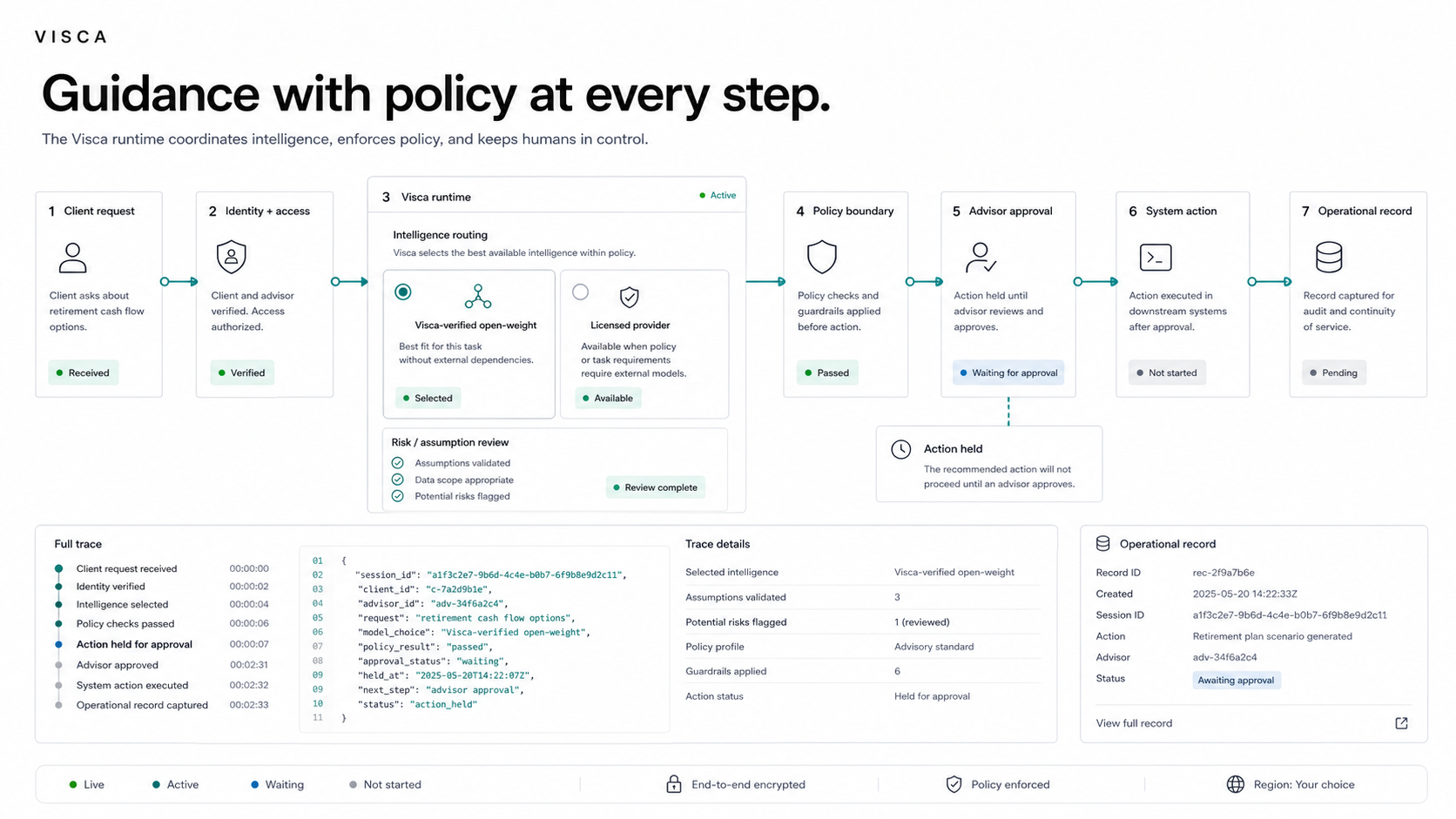
Advisors, specialists, and AI in one governed client workspace—with sensitive data and every decision under the bank's control.Financial work already pulls advisors, analysts, reviewers, customers, and systems into the same decision. Visca gives their AI collaborators a persistent identity and a governed place in that workflow. Everyone works from the same context; people can redirect analysis and approve consequential actions; account data and the complete operational record remain inside the bank's control.
Shared AI work is useful only when authority, data, and consequences remain controlled.
01
Service accounts with the keys to the core
Fraud and reconciliation agents are wired to core banking, payment rails, and ledgers through long-lived service accounts with broad scope. A prompt injection or a compromised runtime becomes a movement-of-funds incident.
02
No examiner-ready record
When an auditor asks 'which automated process issued this refund, under whose authority, and what did it see' — the answer is stitched together from framework traces, vendor logs, and a screenshot. That gap blocks production sign-off.
03
Self-hosted means a second ops org
Keeping the data in means running the stack yourself — and a stitched build of separate projects, each with its own identity, audit trail, and upgrade cycle, turns the bank into the operator of an infrastructure product it never wanted to own.
One shared workspace, not scattered agent threads
The collaboration and control plane around every participant, model, tool, and action.
01Identity
Who is this agent — one answer
Every agent, and every run, carries a verifiable identity bound to the principal that authorized it. Revocation propagates across the estate in seconds. The first question of the review has one answer.
02Credentials
Per-action access to money and records
Every reach into a ledger, a payment processor, or a card network runs on a scoped, time-bound credential — verb, amount, counterparty, duration. The agent never holds a standing key to the core.
03Runtime
Execution inside the bank's perimeter
Agents run inside the bank's walls, under per-actor budgets and circuit breakers. A runaway process is a bounded process, and nothing — prompts, context, outputs — leaves the perimeter.
04Audit
An examiner-ready system of record
Every operation is a principal acting within a scope through one governed gateway, chained and tamper-evident. 'Who issued this refund, under whose authority' is one query, exportable to your SIEM and GRC tools.
05Operators
Who keeps it alive — not your team
The stack ships with its own operators: agents that deploy, upgrade, patch, rotate credentials, and answer incidents inside the perimeter, under the same identity and audit. Maintenance lands on the same ledger the examiner reads.
What the institution gets
Durable control without giving up capability.
Replace standing service-account access with scoped, time-bound credentials
Hand examiners one queryable, tamper-evident record — maintenance included
Run the whole stack inside the bank's perimeter; nothing leaves
Resident operators handle patching, upgrades, rotation, and incidents — recorded
In practice
A duplicate-charge refund agent
A support agent detects a duplicate charge and requests a credential scoped to one refund — capped at $50, for this one customer, valid for thirty minutes. Policy requires a human signature; the approver signs, and the signature lands on the ledger next to the refund it authorized. When compliance reviews the quarter, every refund the estate issued — and every patch the operators applied to the stack underneath — is one query away.
Relevant control frameworks
SOC 2 Type IIPCI-DSSISO 27001GDPR / regional residency