Thesis · v0.2
A technical thesis for shared, persistent, governed AI work.
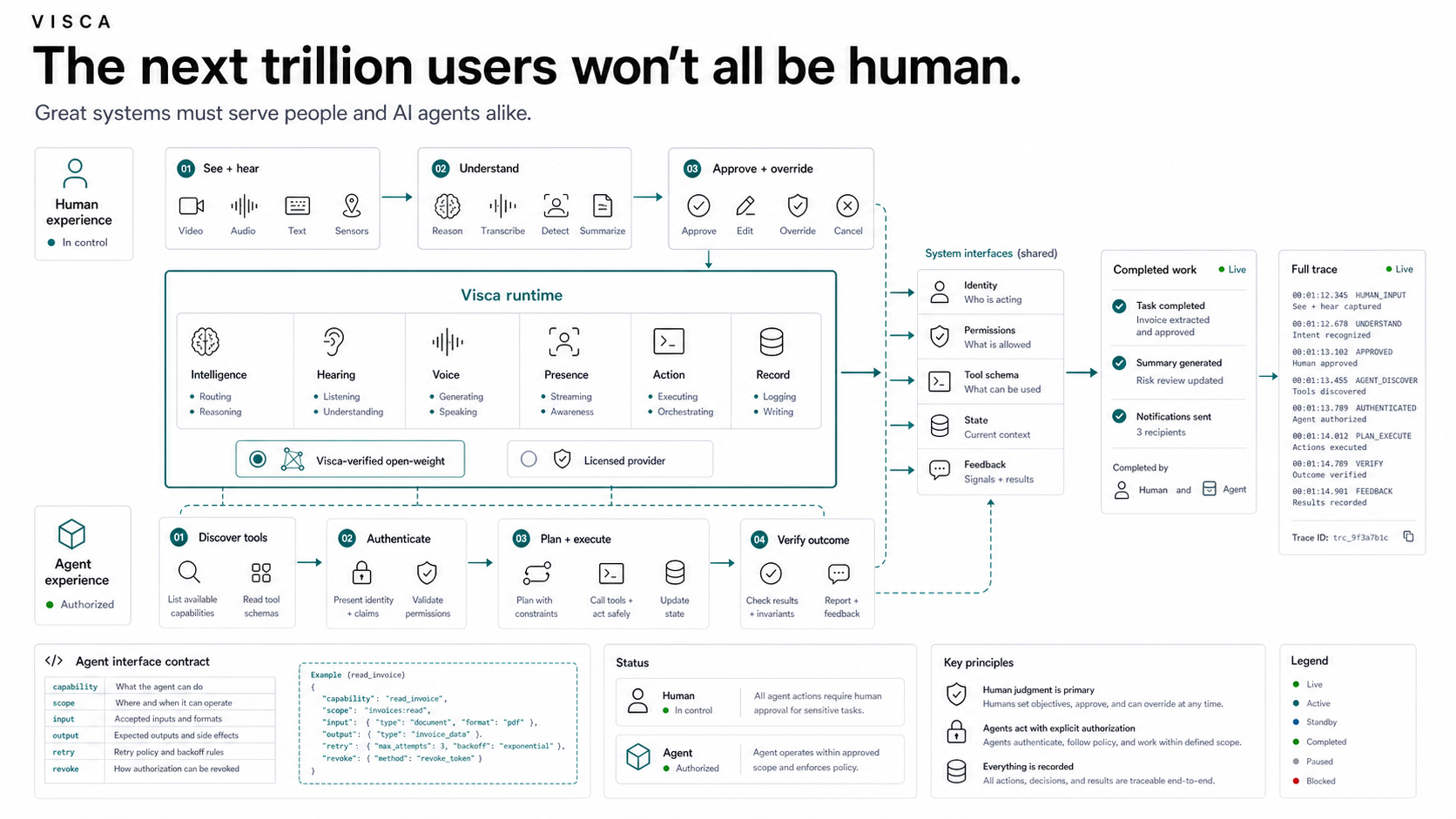
Table of Contents
Contents
- 01The single-player problemp. 2
- 02A shared workspacep. 2
- 03Persistent participantsp. 3
- 04One operational recordp. 3
- 05Human authorityp. 4
- 06Consequential workp. 4
- 07The collaboration runtimep. 5
01 · The single-player problem
AI work is trapped in private threads.
People learned to work together in shared documents, canvases, repositories, and channels. AI went the other way: one person, one agent, one private transcript.
As agents take on work that lasts hours or days, private threads stop being a minor interface problem. Teammates cannot reliably enter the same live session, see the same context, redirect the work, approve a consequential action, or inherit a durable record.
In regulated environments, that shared surface must also answer who participated, what each participant could do, who approved the outcome, and where the record lives.
02 · A shared workspace
Give AI a place on the team.
Visca is the full-stack collaboration runtime for humans and AI: persistent identity, face, voice, shared context, live sessions, authority, and record in one system.
Identity
Every person and AI is a named participant with a persistent identity, role, and history that survives any one session.
Presence
An AI can listen, speak, appear, and act inside the same live workspace as the people and agents collaborating with it.
Authority
People can redirect work, approve actions, revoke access, or stop a run. Capability is explicit and consequential judgment remains human.
Record
One persistent record holds the messages, context, actions, decisions, handoffs, and outcomes of the shared work.
One workspace means the team can enter, understand, intervene, and continue without reconstructing the work from scattered transcripts.
03 · Persistent participants
Identity and context survive the chat.
A useful AI teammate cannot reset to an anonymous prompt box every time someone opens a new tab. It needs a durable identity, approved capabilities, and context the team owns.
Visca keeps the collaboration layer independent of any one model provider. Teams can use open-weight intelligence, licensed providers, or both while retaining the same AI identity, workspace, permissions, presence, and history.
04 · One operational record
Shared work leaves shared history.
Hand-run systems leak history. SSH sessions, console clicks, tribal knowledge — the operations that keep a system alive are exactly the ones that never make the audit log.
A stack operated only by principals acting within scopes, through one governed gateway, closes that gap by construction. Every patch, every credential rotation, every incident recovery lands on the same tamper-evident ledger as the agents' own work — signed, attributable, queryable.
Maintenance itself becomes evidence. The audit trail is not a feature bolted onto the stack; it is how the stack works. There is no off-the-record path, because there is no hand on the box.
05 · Human authority
People remain in control.
Autonomy does not mean absence. It means the human role is narrowed to the decisions that must stay human — and every one of them is recorded.
Declare intent
Humans state what the system is for and what it may pursue. Agents act within that declaration, never beyond it.
Sign approvals
Consequential actions stop at a human gate. The signature, the signer, and the scope go on the ledger.
Hold the kill-switch
Any human with the authority can halt an agent, a workload, or the stack. The halt is itself a recorded act.
Around those three jobs sit deterministic guardrails — policy walls, budgets, circuit breakers — enforced outside the models, where no amount of reasoning can argue past them. In regulated contexts, human approval gates are permanent by design, not a transitional stage to be automated away.
06 · Consequential work
Built where collaboration has consequences.
The first Visca deployment is underway at Stanford Medicine, where multiple practitioners will collaborate with AI inside a real institutional environment.
Compliance certifications are targeted, not claimed. The architecture is built so the evidence exists before the auditor asks for it.
07 · The collaboration runtime
One runtime for humans and AI.
We provide the persistent collaboration layer between people, agents, models, tools, and institutional systems—deployed through our cloud or entirely in your environment.
Your people. Your AI. Working together—without surrendering control.
visca.ai
About Visca
About Visca.
Visca builds the full-stack collaboration runtime for humans and AI— one governed system for identity, presence, shared workspace, authority, action, and record that runs on customer infrastructure or Visca Cloud. For more information, visit visca.ai.