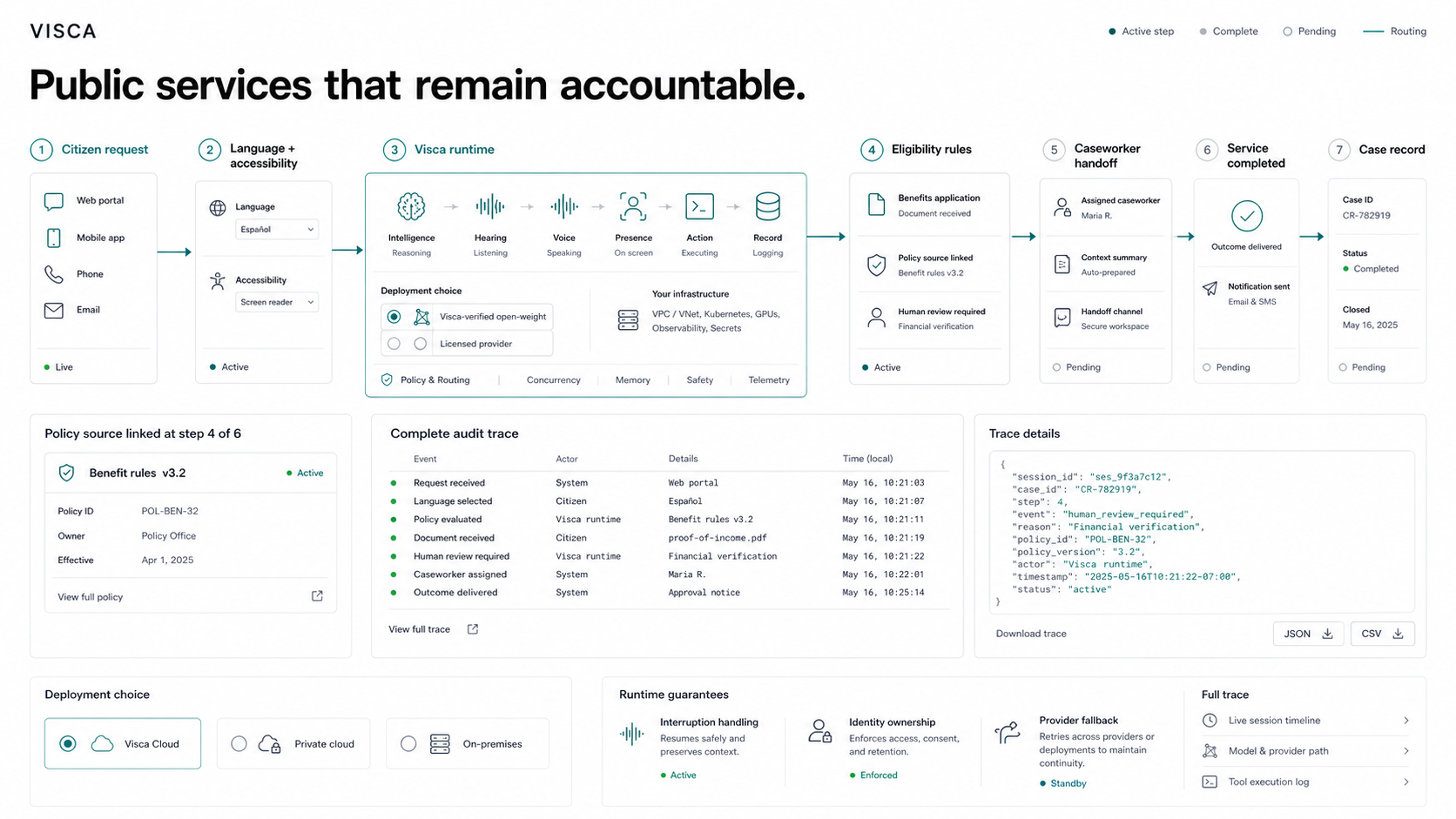
Caseworkers and AI in one accountable service workspace—from citizen request and human review to outcome and case record.Public services involve citizens, caseworkers, reviewers, policy owners, and institutional systems. Visca gives AI a named, governed role in that shared process while keeping sensitive records, permissions, decisions, and session history inside the public institution's boundary—including fully air-gapped environments. Every handoff remains accountable to a person and every outcome remains on one record.
Shared AI work is useful only when authority, data, and consequences remain controlled.
01
No public cloud, no outbound dependency
For classified and sensitive workloads, the runtime cannot phone home. Updates must arrive as offline packages; nothing leaves the boundary.
02
Identity and authority, end to end
Every action by every automated actor must be attributable to an authorizing principal, with a chain back to a human — non-negotiable for accountability in government.
03
Maintenance where no vendor can reach
Inside an air gap, the vendor's ops team doesn't exist. The burden lands on cleared staff, and every hand-run fix — an SSH session, a console change — is unrecorded risk in the most record-sensitive environment there is.
One shared workspace, not scattered agent threads
The collaboration and control plane around every participant, model, tool, and action.
01Identity
Authority traceable to a human root
Every actor's identity chains its lineage back to the principal that authorized it. Accountability is structural, not a logging convention.
02Credentials
Scoped, consented, audited access
Every access is scoped and time-bound, with human sign-off required for consequential actions — audited on both sides of the approval.
03Runtime
Air-gapped operation
The runtime has no outbound dependency. Models run inside the boundary; updates arrive as signed offline packages. Same stack, isolated facility.
04Audit
A record an authorizing official can sign against
Every operation — maintenance included — lands on one tamper-evident, chained record that an investigator can trust and an authorizing official can sign against.
05Operators
Self-maintaining inside the air gap
The stack's own operators deploy, upgrade, patch, rotate credentials, and answer incidents inside the boundary. Humans declare intent, sign approvals, and hold the kill-switch — all three recorded.
What the institution gets
Durable control without giving up capability.
Air-gapped, self-managed deployment with signed offline updates
Every action attributable to an authorizing human
Maintenance performed in-boundary by resident operators — recorded
Controls mapped to recognized federal frameworks
In practice
An air-gapped analysis estate
Inside an isolated facility, analysts run autonomous workflows over sensitive data. The runtime never reaches the internet; updates arrive on signed offline media and are applied by the resident operators under scoped credentials. Every action chains to an authorizing officer, and the record — workloads and maintenance alike — is the authoritative, tamper-evident ledger the authorizing official signs against.