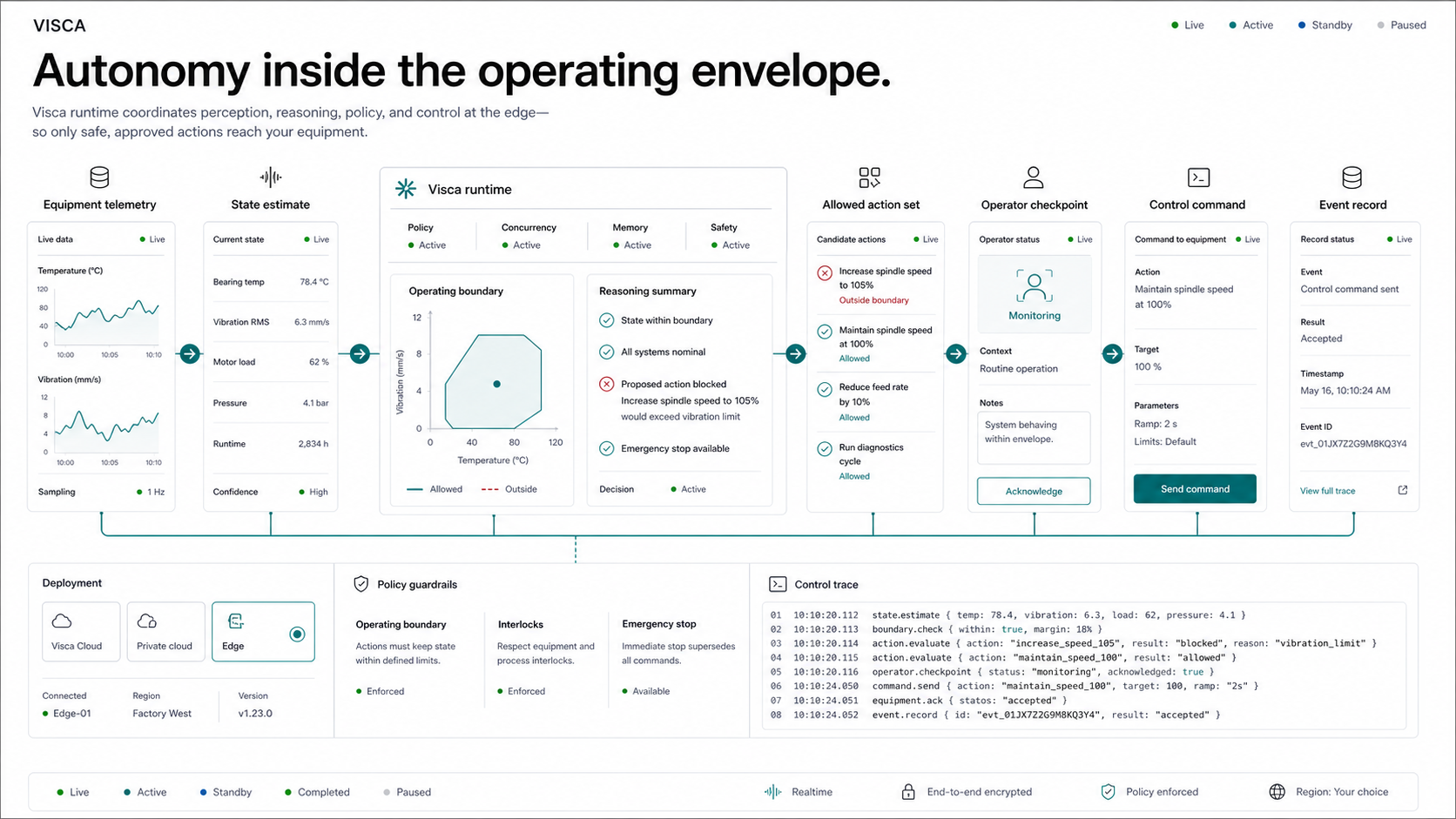
Engineers, operators, and AI inside one operating envelope—with live telemetry, human override, and every command recorded.Manufacturing and energy operations run hybrid fleets of software planners, PLCs, and physical machines — and the process recipes, yield data, and plant telemetry that move through them are trade-secret data that stays on the floor, off any vendor cloud. Today that means a stitched estate: planners on one platform, machines in vendor consoles, safety written into application code, audit scattered across clouds — assembled per line, per site, per vendor, and patched by whoever has time. Visca runs the estate as one stack inside your network — one identity model, one credential model, one runtime with safety envelopes, one record — with its own operators keeping every site current.
Shared AI work is useful only when authority, data, and consequences remain controlled.
01
Configuration drift, site by site
Fleet configurations live in middleware configs, vendor consoles, and tribal knowledge. Two sites drift apart, and nobody can show a reviewer what's actually running at either one.
02
Safety as application code
Operational limits and interlocks are written into application logic, differently by every team. Auditing them is reading code, not reading a policy.
03
Incident reconstruction across vendors
When a line faults, telemetry is in one vendor's cloud, interventions in another log. Reconstructing the sequence takes days.
One shared workspace, not scattered agent threads
The collaboration and control plane around every participant, model, tool, and action.
01Identity
Attested machine identity
Each machine carries an attested identity. Commands are cryptographically attributable to a specific machine in a specific configuration.
02Credentials
Scoped authority over the line
A command to a machine runs on a scoped, time-bound credential — this machine, this operation, this window — not a standing connection from planner to floor.
03Runtime
Safety envelopes as policy, not code
Operational limits and interlocks — geofences, force limits, allowed operations — are enforced uniformly by the runtime across vendors. Auditing them is reading policy.
04Audit
One replayable incident timeline
Every planner decision, actuation, and operator intervention lands in one chained record. A line fault is reconstructed in minutes, not days.
05Operators
Every site current, without a per-site crew
The stack's own operators deploy, upgrade, patch, and rotate credentials across sites — recorded, so what's running at each site is answerable from the ledger, not from memory.
What the institution gets
Durable control without giving up capability.
Keep recipes, yields, and telemetry inside your own network
Enforce operational safety limits as auditable policy
Attribute every machine command cryptographically
Resident operators keep every site patched and current — recorded
In practice
A line-fault postmortem
A packaging line halts on a safety interlock. The postmortem is a replay of one record: the planner's command, the credential behind it, the attested machine identity, the envelope check that tripped, and the operator's reset — one timeline, across planner software and floor hardware, reconstructed in minutes. The fix ships through the resident operators, and the patch lands on the same record the postmortem cites.
Relevant control frameworks
SOC 2 Type IIIEC 62443 (industrial security)Functional-safety alignment